


Products Feature
Photoelectric Smoke Detection
The Smoke Detector Control Board can process signals from an optical smoke chamber, measuring changes in light scattering when smoke particles enter the sensing area.
Alarm Trigger and Indication
Controls buzzers, indicator LEDs, and alarm outputs when smoke readings meet defined detection criteria. Alarm thresholds and response logic depend on the detector design.
Sensor Chamber Supervision
Monitors sensor behavior to help identify contamination, signal drift, or abnormal readings that may affect detection performance.
Battery and Power Monitoring
Supports low-battery warnings, power supervision, and sleep modes for battery-operated detectors. Mains-powered designs can incorporate backup battery monitoring.
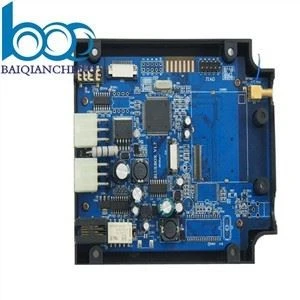
PCBA Display


Products Advantage
Designed for Low Standby Consumption
The Smoke Detector Control Board can use periodic sensor sampling and low-power microcontrollers to reduce energy consumption between detection cycles.
Reduced Unwanted Alarms
Signal filtering and appropriate alarm algorithms help distinguish persistent smoke conditions from brief electrical disturbances or isolated sensor fluctuations.
Compact Detector Integration
The circuitry can fit within ceiling-mounted or wall-mounted detector housings, leaving room for the optical chamber, sounder, battery, and mounting components.
Support for Interconnected Alarms
Depending on the design, wired or wireless communication can allow multiple detectors to share alarm signals across a building.
Manufacturing Process
PCB assembly requires careful handling of optical sensing circuits, low-noise analog components, microcontrollers, and sounder drivers. After SMT assembly and firmware programming, production checks can cover sensor signal response, buzzer operation, LED indication, standby current, and low-battery warnings. Smoke sensitivity verification requires controlled smoke-test equipment and procedures appropriate to the detector specification.
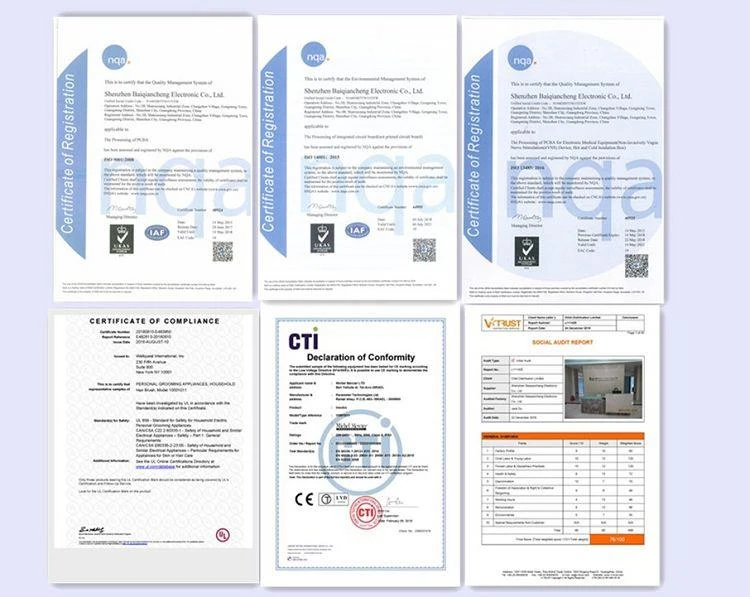
Certifications
Services
BQC provides Smoke Detector Control Board PCBA manufacturing, component procurement, DFM review, firmware programming, and prototype-to-volume production support. We can also assist with optical sensor assembly, functional test fixture development, battery contact installation, and final electronic module assembly. Product-specific testing can be arranged according to customer specifications and applicable safety requirements.
FAQ
Q: What sensing technology can the board support?
A: It can be designed for photoelectric smoke detection using an LED and photodetector inside an optical sensing chamber.
Q: Can the board support battery-powered smoke alarms?
A: Yes. Low-power operation, battery voltage monitoring, and low-battery warning functions can be incorporated into the circuit design.
Q: How does the board help reduce false alarms?
A: Sensor signal filtering, threshold management, and repeated sampling can help reduce unwanted alarms. Performance must be validated through detector-level testing.
Q: Can multiple smoke detectors be interconnected?
A: Yes. Wired or wireless interconnection can be implemented to share alarm information between compatible detectors.
Q: Can BQC manufacture boards for UL 217 or EN 14604 smoke alarms?
A: Yes. We can manufacture PCBAs according to customer designs intended for these standards. Certification and compliance must be verified through the required testing of the complete smoke alarm product.
Hot Tags: smoke detector control board, China, manufacturers, factory, customized


