


Products Description
The Programmable Automation Controller PCBA is engineered as a versatile, high‑performance processing engine for industrial automation and machine control. It integrates a powerful multicore CPU or system‑on‑chip with extensive real‑time I/O capabilities, supporting both ladder logic and high‑level programming languages. The board features isolated digital inputs for sensor and switch monitoring, high‑current digital outputs for relay and solenoid actuation, and multiple analog input channels with 16‑bit ADCs for precision measurement of 4‑20mA or 0‑10V signals. Dual redundant Ethernet ports with integrated switch support PROFINET, EtherNet/IP, and Modbus TCP for seamless factory network integration. A dedicated motion control coprocessor handles up to 8 axes of coordinated motion with encoder feedback. On‑board diagnostics include power supply monitoring, temperature sensing, and a watchdog timer for fail‑safe operation. The PCB uses high‑temperature FR4 material with separate analog, digital, and power planes, and a carefully designed grounding scheme to maintain signal integrity. Designed for DIN‑rail or panel mounting, the PCBA supports wide DC input ranges and extended operating temperatures, with conformal coating for protection against dust and moisture in harsh manufacturing environments.
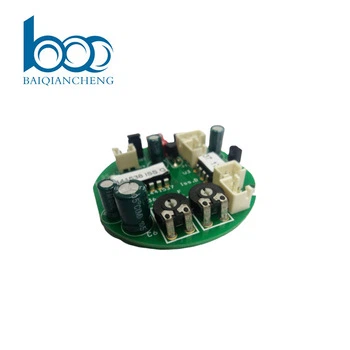
PCBA Display



Production Process
The assembly of high‑performance PAC boards demands careful handling of dense BGA packages, high‑current power stages, and precision analog sections. Solder paste printing uses Type 4 or Type 5 powder with SPI to ensure consistent volume on fine‑pitch pads of the multicore CPU, FPGA, and high‑pin‑count analog ICs. Reflow is performed with a multizone oven under nitrogen, using a profile that provides sufficient thermal energy for large BGA packages without overheating sensitive analog components. X‑ray inspection is mandatory for all BGAs and power inductors, checking for void levels and alignment. After reflow, selective soldering attaches thru‑hole connectors (terminal blocks, Ethernet jacks, power entry) and any board‑to‑board headers. A robotic selective coating robot applies a thick conformal coating to protect against dust and condensation, with mask tooling protecting connector pins, test points, and edge‑card fingers. Board depanelization uses routing with entry/backup material to prevent burrs on narrow board sections. Final assembly includes installation of heatsinks on the CPU and power devices, along with any battery holders and LED light pipes. Each board then undergoes powered programming of the bootloader and operating system, followed by a final visual inspection under UV light to confirm coating coverage before packing in anti‑static bags with humidity indicator cards. All assembly is performed in ESD‑safe workstations with controlled humidity.
Production & Quality
Our manufacturing process for programmable automation boards follows rigorous quality protocols to ensure reliable real‑time control. Each board undergoes In‑Circuit Test (ICT) and a comprehensive Functional Test (FCT) using a test rack that simulates a live control network. The FCT validates analog input accuracy against calibrated sources, analog output drive capability, digital I/O timing and current ratings, dual Ethernet port communication with redundancy failover, and motion control pulse trains. Watchdog timer and power monitoring circuits are also verified.
We utilize advanced SMT lines with 3D SPI, Automated Optical Inspection (AOI), and X‑ray for BGA and power packages. Conformal coating is applied to protect against dust and moisture. Each board passes a 48‑hour burn‑in test at elevated temperature with continuous I/O cycling and network traffic to screen early failures.
Our supply chain includes long‑term agreements with CPU, FPGA, and analog IC suppliers. Standard lead time is 8‑10 weeks for volume orders. With high‑precision placement lines and dedicated industrial test racks, we maintain scalable capacity to meet factory automation project schedules while ensuring consistent quality and on‑time delivery.
Q&A
Q: In a Programmable Automation Controller, what is the most overlooked factor that limits real‑time performance in field deployment?
A: The most overlooked factor is memory access contention between the CPU and FPGA, especially when both access the same shared memory bus. A Programmable Automation Controller PCBA often needs deterministic cycle times under 100µs, but if the FPGA frequently stalls the CPU to read/write large blocks of I/O data, the PLC task may be delayed. We solve this by implementing a dual‑port RAM architecture with a dedicated DMA controller that moves data between FPGA and CPU without stealing cycles. During FCT, we run a worst‑case contention test where the FPGA performs constant memory transfers while the CPU executes a time‑critical loop. The board passes only if jitter is below 5µs.
Q: How do you test the PAC's deterministic real‑time performance before shipping?
Answer: We built a precision timestamp generator that injects a pulse train into a high‑speed digital input. The PAC is programmed to read the input and toggle an output with minimal latency. The fixture measures the time difference between the input pulse and the output edge – this is the PAC's response time. We run this test with the CPU and FPGA under maximum load (all I/O channels active, full network traffic). Passing boards show jitter under 20µs. Each board's response histogram is stored in a production database for traceability.
Q: What specific measures do you take to safeguard the PAC against voltage dips or brownouts, which are common in industrial environments?
Answer: We design a multi‑stage power supply with:
A supercapacitor bank on the 24V input that holds up the board for 50ms after the supply drops – enough for a clean shutdown.
An independent voltage supervisor that issues a reset signal to the CPU if any rail falls below 95% of nominal, triggering an immediate state save to FRAM.
A power‑good combiner that prevents the processor from booting until all rails are stable.
During FCT, we intentionally drop the input voltage to simulate a 50ms brownout and verify that the FRAM contents are restored correctly after power returns. This is tested on every unit, not just samples.
Certificates


Hot Tags: programmable automation controller pcba, China, manufacturers, factory, customized


