

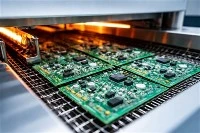



In - depth Analysis of PCBA Testing Methods to Ensure Electronic Product Quality
In today's era, highly reliant on electronic devices, PCBA (Printed Circuit Board Assembly), as the core component of electronic products, directly impacts their performance and reliability. However, the PCBA manufacturing process is complex. Issues can arise from equipment malfunctions or operator errors, making it hard to ensure all products meet standards. Thus, PCBA testing is crucial for product quality. Let's explore its main testing methods.
There are five key types of PCBA testing:
1. ICT Testing: Precise Circuit Diagnosis
ICT (In - Circuit Test) acts like a skilled circuit "doctor". It carefully checks the circuit's micro - world. It can accurately detect circuit continuity, ensuring the current path is unobstructed. It also precisely measures voltage, current values, as well as their fluctuation curves, amplitudes, and noise. Abnormalities in these parameters may signal potential problems. For example, a voltage out of range might indicate a component issue, and abnormal noise could suggest electromagnetic interference. ICT testing safeguards the PCBA circuit quality.
2. FCT Testing: Comprehensive Functional Simulation
FCT (Functional Circuit Test) is a full - scale simulation of the PCBA's functionality. First, an IC program is burned, giving the PCBA the "soul" to run its functions. Then, using special production fixtures and test racks, it tests the PCBA's functions. It checks for hardware and software issues, from basic signal transmission to complex system functions. For a smartwatch PCBA, it simulates functions like time display, heart rate monitoring, and Bluetooth connection to ensure stable operation.
3. Fatigue Testing: Simulating Long - term High - frequency Use
Electronic products often need to work continuously and be used frequently. Fatigue testing mimics such scenarios. Samples of PCBA boards are selected and subjected to long - term, high - frequency function operations. Testers watch for failures. By accumulating test data, they determine the probability of failure to assess the PCBA's performance. For a tablet PCBA used for long - term video playback, it simulates continuous playback to check for issues like freezes or stutters.
4. Harsh Environment Testing: Challenging Limits for Quality Assurance
Electronic products may encounter harsh environments. Harsh environment testing exposes PCBA boards to extreme conditions such as temperature, humidity, drops, splashes, and vibrations. By obtaining test results of random samples, it infers the reliability of the entire batch. For an outdoor communication base station PCBA, it may be tested under high - temperature, high - humidity, and vibration conditions to ensure stable operation.
5. Burn - in Testing: Long - term Power - on for Stability
Burn - in testing is a crucial pre - shipment quality check for PCBA boards and electronic products. They are powered on for an extended period, and testers monitor for failures. Long - term operation may cause problems due to component heating and aging. Only after passing this test can products be sold in batches. For a server PCBA, it may undergo burn - in testing for days or weeks to ensure no serious failures like crashes or data loss occur.
These five PCBA testing methods safeguard PCBA quality from various aspects, laying a solid foundation for electronic product performance and reliability. As electronic manufacturing technology advances, optimizing and perfecting PCBA testing will always be our pursuit of excellence.


