

How AI Is Reshaping PCBA Manufacturing in 2026: From Smart Inspection to Predictive Yield
For decades, PCB assembly has been optimized around a familiar loop: print solder paste, place components, reflow, inspect, rework. The hardware got faster and more precise, but the intelligence behind the line stayed largely human - operators reading SPC charts, engineers tuning reflow profiles by trial and error, and quality teams sorting through AOI false calls.
That model is ending. In 2026, artificial intelligence has moved from the conference keynote to the production floor, and it is rewriting how EMS partners control quality, protect yield, and keep high-mix lines running.
Inspection that learns instead of flagging
Traditional automated optical inspection (AOI) relies on rule-based algorithms. Program an acceptable solder-joint window, and anything outside it gets flagged. The result is a familiar pain point: false-positive rates that can run into double digits, with operators spending hours re-verifying boards that are actually fine.
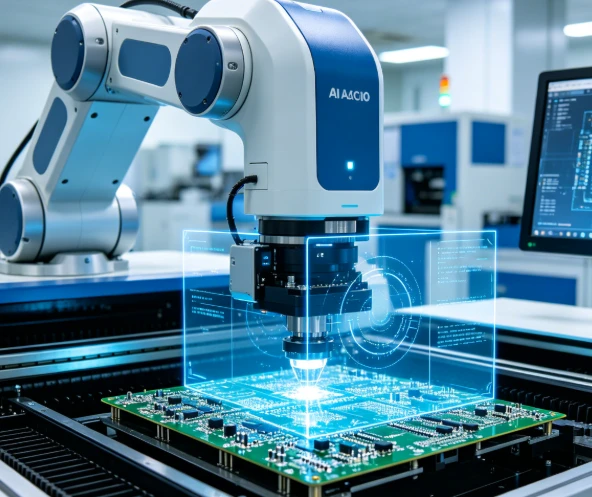
The new generation of AI-powered AOI is trained on millions of verified board images. Instead of comparing against a static rule set, deep-learning models recognize the subtle geometry of a good joint versus a cold one, a tombstoned 0201, or a head-in-pillow BGA. Leading lines now report false-call rates below 0.5% while catching genuine defects that rule-based systems miss. Combined with 3D solder paste inspection (SPI) and automated X-ray (AXI) for hidden joints, AI inspection has become the backbone of modern yield control.
Closed-loop process control
The bigger shift is that inspection data no longer sits in a quality log. Closed-loop MES systems feed SPI and AOI results back upstream in real time. If paste volume drifts on a fine-pitch QFN, the printer adjusts its squeegee pressure or stencil cleaning cycle before the defect becomes a board-level escape. If a particular nozzle shows rising placement error, the line flags it for maintenance before it causes a crash.
This is the difference between detecting defects and preventing them.
Predictive maintenance protects margin
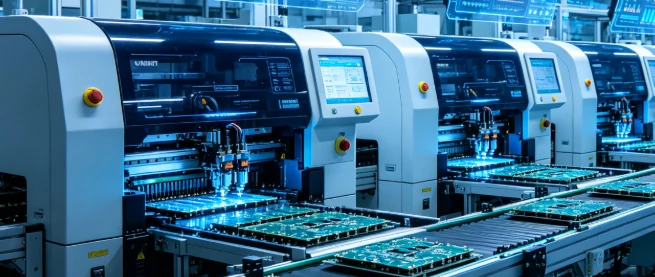
Unplanned downtime is the silent killer of EMS profitability, especially on high-mix, short-cycle lines where every hour of stoppage cascades into missed deliveries. AI-driven predictive maintenance analyzes sensor data from feeders, nozzles, conveyors, and reflow ovens to forecast failures before they happen. Shops that have adopted the approach consistently report 20–40% reductions in unplanned downtime, shifting from calendar-based servicing to condition-based alerts.
What this means for OEMs
For product teams sourcing PCBA in 2026, the question is no longer whether a partner has an SMT line - it is whether that line is instrumented, connected, and learning. A smart factory reduces escapes, stabilizes yield across design revisions, and shortens the ramp curve for new products. Those advantages compound as boards get denser, components get smaller, and product lifecycles get shorter.
AI is not replacing the engineering judgment that still defines a great EMS partner. It is amplifying it - turning decades of tacit process knowledge into data that every shift, every line, and every new product can build on.


