

What New Requirements Does AI Infrastructure Bring to PCBA?
Traditional PCBA projects often focus on cost, production efficiency, and basic functional performance. However, electronics used in AI infrastructure may operate continuously under high loads, requiring significantly higher levels of electrical and thermal reliability.
One major requirement is the manufacturing of high-power electronics.
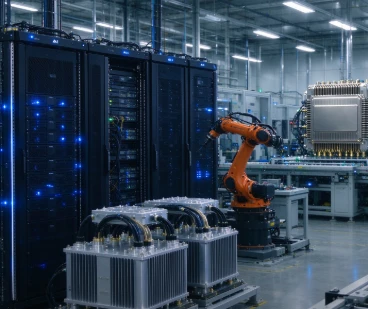
AI servers and data centers are increasing power density across power supplies, power distribution systems, UPS systems, energy storage systems, and power conversion equipment. These applications may require thicker copper PCBs, high-Tg materials, appropriate copper weights, improved thermal management, and carefully designed power paths.
Another important requirement is high-density PCB assembly.
Advanced computing equipment requires more processing capability within increasingly compact system architectures. PCBs may therefore contain a high number of ICs, BGAs, connectors, and other high-density components.
For complex assemblies, inspection methods such as SPI, AOI, and X-ray inspection can be combined to identify different types of manufacturing defects. X-ray inspection is particularly useful for components such as BGA and QFN, where solder joints cannot be completely inspected through conventional optical inspection.
Why Is DFM Becoming More Important for AI PCBA?
For high-complexity electronic products, PCBA manufacturing should not begin only after the design has been completed.
DFM, or Design for Manufacturability, should be introduced as early as possible in the product development process.
During the design and engineering stage, an experienced EMS partner can review:
Component availability
PCB materials and copper thickness
BGA and fine-pitch component placement
SMT pad design
Component alternatives
PCB panelization
Test-point design
Thermal management
Manufacturing feasibility
Component lifecycle
Supply-chain risks
Early DFM analysis can help reduce engineering changes, production delays, rework, and unexpected manufacturing costs.
For AI infrastructure products, this early collaboration is particularly important because hardware designs often combine high-speed digital circuits, high-power components, complex thermal requirements, and strict reliability expectations.
How Does PCBA Testing Improve Reliability?
High-reliability electronics generally require more than one inspection or testing method.
A typical quality-control process may include:
SPI → AOI → X-ray → ICT/Flying Probe → FCT → Aging/Burn-in
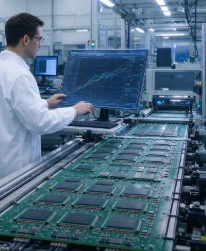
SPI can evaluate solder-paste printing, while AOI can identify component placement and soldering defects. X-ray inspection can examine hidden solder joints underneath BGA and QFN components.
ICT or Flying Probe testing can verify electrical connections, while Functional Circuit Test (FCT) evaluates whether the assembled PCBA performs according to its intended electrical and functional requirements.
For power electronics, energy storage, industrial control, and other high-reliability applications, additional functional testing, load testing, and aging tests may also be required.
This means that the competitiveness of a modern PCBA manufacturing company is no longer determined simply by the number of SMT lines it operates. Engineering capability, component sourcing, automated production, inspection, testing, traceability, and production scalability are becoming equally important.
BQC's High-Power PCBA Manufacturing Capabilities
BQC Electronics provides EMS and PCBA manufacturing services for applications including AI infrastructure, power electronics, energy storage, industrial control, and new energy systems.
Our manufacturing capabilities cover the complete production process, including PCB sourcing, component sourcing, SMT, DIP, assembly, functional testing, aging, and box build.
BQC also supports advanced quality-control processes such as SPI, AOI, X-ray, ICT, and FCT. For high-power electronic applications, our manufacturing experience includes thick-copper PCB assemblies, BMS, PCS, inverter, and other power-control electronics.
As AI infrastructure and high-power electronic systems continue to evolve, PCBA is becoming much more than a basic electronic assembly. It is increasingly connected to system performance, product reliability, supply-chain stability, and time to market.
For OEMs and technology companies, working with an EMS partner capable of integrating DFM, supply-chain management, PCBA manufacturing, testing, and box build can provide significant advantages throughout the product development and production lifecycle.


