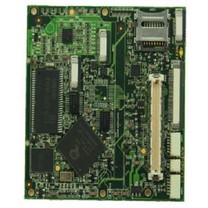
Board-to-board connectors are indispensable miniature coupled plugs and sockets that directly connect power and signal between printed circuit boards (PCBs). They are usually in-line or connector pins in a straight line. Board-to-board connectors usually use copperalloy that resists oxidation to prevent degraded conductivity over the years.
In electronics manufacturing, an entire device or equipment may need to fit a certain available space such as 19-inch (0.5 m) wide racks. If the PCB in the circuit board design stage tends to use up too much space, the device may be split into two or more boards. Board-to-board connectors may join power and signal between the boards to complete all connections.
The use of board-to-board connectors simplifies the circuit board design process. Smaller PCBs would require manufacturing equipment that may not accommodate a combined bigger PCB. Whether a device or product will be squeezed into a single PCB or multiple PCBs is a question on power dissipation, undesired intercoupling of signals, availability of smaller components, and overall cost of finished device or product, among others.