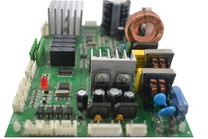
The four elements affecting the effectiveness of wave soldering are, in order of weight of their influence: solderability of the base metal, wave soldering equipment, wave soldering processability of the PCB graphic design, and optimisation of the wave soldering process. The following to analyse these issues.
The solderability of the base metal
Base metal refers to the PCB pad and component pins, wherever there has been a wave soldering practice will be deeply touched, that is, as long as the base metal weldability is good, the other elements of the welding effect of the impact of the sensitivity will appear to be very slow, that is, the process window widens significantly. This is why the solderability of the base metal is always considered as the first factor affecting the soldering effect. Supplier-provided PCB pads and component pins must be good solderability, and can withstand the storage of pre-soldering and multiple soldering temperature effect without degradation. PCB solderability coating is obtained, there are several methods (only lead-free PCB coating).
(1) organic solderability protection coating (OSP)
This coating material is easy to handle, compatible with lead-free brazing materials such as SAC, relatively free of ionic impurities, flat and smooth surface. the thickness of the OSP coating is usually 0.2 ~ 0.5 μm, too high a preheating temperature (such as 130 ° C) will make it lose its protective effect. In the preheating process because OSP is compatible with water-soluble flux, the active agents and solvents in the flux will quickly dissolve the OSP coating, making it part of the flux, which will evaporate when the melted brazing material touches the PCB.
This coating material storage time is short, even in dry N2 storage can not exceed 12 months.
(2) Im-Sn Coating
Im-Sn coating has good surface flatness and is easy to handle. When using this coating, it must be considered that at higher soldering temperatures it can lead to outward diffusion and oxidation of the base metal, which makes solderability degrade. In addition the tin whisker problem is considered to be a major obstacle to Im-Sn.
(3) Im-Ag Coating
Im-Ag coating is directly on the copper conductor immersion silver, its thickness is 0.127 ~ 0.254 μm, the immersion silver layer is semi-gloss silver, its surface state and flatness is basically the same as the copper surface state.
In order to assess the reliability of the silver dip coating, some foreign scholars were silver dip layer of 144 I / O narrow pitch (0.8mm) and 156 I / O pitch (1mm) of the surface array component reliability of the implementation of thermal cycle test. A temperature variation range of -40 to 125°C was used as a comparison with the HASL braze coating results. The temperature ramp rate was 8 to 10°C/min. 144 I/O devices underwent 254 to 1264 cycles and 156 I/O devices underwent 546 to 1754 cycles, and the tests showed that the thermal cycling reliability of the Im-Ag layer was comparable to that of HASL. The Ag-Sn intermetallic compound formed at the solder joint interface does not have much effect on the thermal cycling reliability because of the low silver content. Because of the small amount of silver on the pad surface, there is also no brittleness effect on the solder joint.
(4) ENIG-Ni/Au Coating
ENIG-Ni / Au surface of the secondary interconnect reliability, than Im-Ag or HASL brazing material surface coating of the reliability of the poor. LonChase in the test by the solder joints of the cross-sectional analysis, found in the interface between the components and pads adjacent to the Ni layer of Sn layer contains gold. Sn-Au layer of lead-rich areas will be completely spread throughout the entire solder joints, the interface of the Au - Sn metal The high concentration of Au-Sn intermetallic compounds at the interface suggests that the spreading of Au across the solder joint is not uniform.