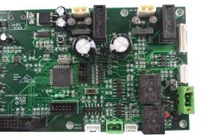
Comparative tracking index (CTI): the maximum voltage value of the material surface that can withstand 50 drops of electrolyte (0.1% ammonium chloride aqueous solution) without forming leakage trace, unit: v
Polymer insulating materials have a special phenomenon of electrical damage, that is, the surface of polymer insulating materials will be degraded by electric traces under specific conditions, and the damage will be eliminated and it can lead to electric mark damage.
Electric mark damage refers to the gap (called drying zone) formed by the separation of liquid film on the surface of material when there is moisture and pollution on the surface of material and the electric field is large enough, the surface will have leakage current, and the water will be evaporated under the Joule heat of current.
At the moment of the formation of the drying zone, the electric field strength between the liquid film reaches the discharge field strength, which leads to the discharge. The heat generated by the discharge causes partial carbonization on the surface of the material. Due to the high conductivity of the carbonized products, the electric field density here concentrates on the carbonized part, causing the discharge to occur repeatedly. More carbides are generated around it, forming the carbonized conductive circuit and extending towards the electrode, which eventually leads to the short circuit The road.
Therefore, it is very important to select PCB materials that meet the corresponding CTI values according to the requirements of different PCBA products.
Test short circuit current
According to GB / t4207-2003, the test short-circuit current should be set to 1 a before the test. There are two possible situations
(1) The short-circuit current is only set once for different test voltages;
(2) Short circuit current is set separately for each test voltage. For different test voltages, set the short-circuit current only once. For example, when the test voltage is 200 V and the short-circuit current is 1 A, then increase the test voltage to 300 V and verify the short-circuit current, it can be found that the current exceeds 1 A. If the short-circuit current is verified when the test voltage is reduced to 150 V, it will be found that the current is less than 1 A. Therefore, in order to ensure that the test meets the requirements of the standard, the short-circuit current should be adjusted again every time the test voltage is adjusted.
Droplet size
The drop size specified in GB / t4207-2003 should be controlled within 44 drops / ml ~ 45 drops / ml. In the experiment, the number of drops can be controlled by the drop counter, so how to determine that 44 ~ 45 drops is 1 ml? The author summarizes a simple and effective method. Since the percentage concentration of NH4Cl solution is 0.1% and the amount of NH4Cl is very small, the density of the solution can be set as 1 g / ml. The solution is injected into the dropper, a small container is used, the weight of the empty container is weighed first, and then the small container is placed under the dropper to contain the drops. Start the instrument, drop 44 ~ 45 drops of NH4Cl solution, and weigh the small container. The weight of 44 ~ 45 drops can be obtained by subtracting the two weights. If the weight is 1 g, it means that 44 ~ 45 drops of solution is 1 ml; if it is more than 1 g, it means that the drop volume is too large, and the drop volume delayer should be adjusted; if it is less than 1 g, it means that the drop volume is too small, and the drop volume delayer should also be adjusted. In this way, the droplet size can meet the standard requirements.
Cleaning of electrodes
GB / t4207-2003 stipulates that the electrode shall be cleaned after the test. That is to say, after each test, the electrode should be cleaned, whether at the same voltage or at different voltages. Cleaning agent or alcohol can be used for cleaning, but corrosive cleaning agent shall not be used. After cleaning, the deionized water or distilled water used to prepare NH4Cl solution shall be used to wash. If the sample burns during the test and makes the platinum electrode melt, the electrode shall be repaired in time. When trimming, the ablated part can be gently polished with more than 1200 mesh sandpaper to remove the ablation marks. When grinding, be very careful not to change the contour of the electrode, keep the angle R of the electrode edge unchanged, do not change the electrode edge into a cylindrical surface, and still keep a sharp state, but do not become sharp.